Experience · 3 trips
The Silk Road
The Silk Road is a name almost everyone knows - a name from books and documentaries with camels and caravans somewhere far to the west. But few know that it is still a real road and that you can drive the Chinese part yourself: two thousand years of ancient cities, grottoes, passes and mosques along one corridor, with snow mountains, grassland, lakes, Gobi and desert taking turns outside the window.
- Trip length
- 11 to 13 days
- When to go
- May to October
- Physical demand
- Some destinations are at high altitude, with optional hikes.
- Regions
- The northwest: Gansu, Qinghai and Xinjiang
- Driving
- Medium to long daily distances . Good roads conditions.
For two thousand years this road was China's link to the rest of the world. Historically the caravan routes carried on from there through Central Asia and Persia all the way to the Mediterranean. The part we are talking about here is the Chinese section and it is the best way to drive into Chinese history. With wide open country and long straight roads, with the landscape changing from one day to the next you also drive through some of the most beautiful and most varied nature in China.
One road, many roads
The Silk Road is the historical corridor in China best suited to a road trip. From Xi'an it runs four to five thousand kilometers west, through the Hexi Corridor, into the vast country between the Tianshan mountains and the Taklamakan desert, and on to the gateway of Central Asia.
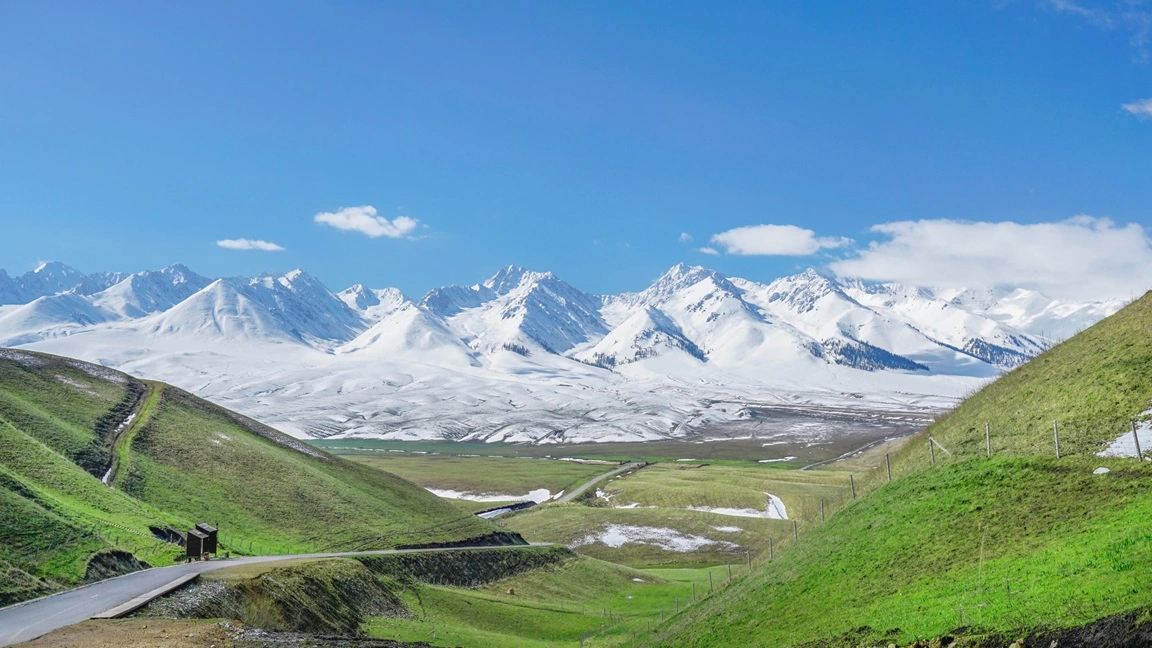
We drove the Qinghai and Gansu loop in July 2025 with our two boys, and what impressed us most was how much the country changes in a single day. We left the Chaka Salt Lake in the morning and by the afternoon we were on a straight highway across the Gobi desert, and then on a hotel terrace looking straight at the dunes. Xinjiang was the same: a pass with snow beside the road in July, camels standing on the road that we avoided, then a green valley and a yurt where a Kazakh family poured us milk tea before we drove on. The scenery is changing amazingly fast and we drove right through it.
But the Silk Road is not a single road, it is a network. It changed with the rise and fall of empires, and once it enters Xinjiang it splits into a northern and a southern route. So there is no one right way to drive it, and it is almost impossible, and not something we would recommend, to drive all of it in one trip. That's why we have divided it into an eastern section and a western section, each with road trips that stand on their own. You can drive one section, or join several routes together into a longer Silk Road crossing.
The eastern section: the classic Silk Road
The eastern section is where Chinese civilization first met the civilizations of the west. More than two thousand years ago the Han empire opened the Hexi Corridor and founded four garrison towns between the Qilian mountains and the Gobi, Wuwei, Zhangye, Jiuquan and Dunhuang, pushing its frontier out past the Jade Gate. Buddhism entered China along this same corridor, and a string of grottoes, from the Mogao Caves at Dunhuang to the Mati Temple at Zhangye and the Bingling Temple near Lanzhou, marks its journey east. For two thousand years this has been the meeting place of the Central Plains and the steppe, of farmers and herders. Different peoples came, settled and left their mark, and you can still read those layers of history in the temples, the old towns and the tents of the herders.
The classic way to drive the eastern section is to follow the Hexi Corridor from Lanzhou to Dunhuang, taking in the four garrison towns, the Great Wall passes and the grottoes along the way. The roads are good and the pace is comfortable, and a week is enough. Two things to know: the route is mostly historical sites in and around the cities, with less natural scenery, and it is a one-way route. It ends at Dunhuang, where you can continue west into the longer western section. If you want to come back the way you came, that needs separate planning. Ask us for the details of this route.
Our recommendation is the Qinghai and Gansu loop. It takes the Hexi Corridor and adds a crossing of the Qilian mountains into Qinghai, which brings in Qinghai Lake, the Chaka Salt Lake, the Qilian grasslands, the Danxia hills, the Yardang landforms, the Gobi and the desert. It also goes deep into Tibetan, Mongol and Yugur country, so history and landscape take turns from one day to the next. Allow about two weeks. The altitude moves between 2,000 and 3,800 meters. This is a complete northwest trip in the true sense, and if you only plan to drive the Silk Road once, it is our first choice.
The western section: the Silk Road beyond Dunhuang
Past Dunhuang, the Silk Road leaves the Central Plains for good and heads for Central Asia, Persia and the far west. This is the sequel: further, longer and much less traveled, and the place where a chapter of Chinese history turns into a chapter of world history. In Xinjiang the road splits along the Tianshan mountains. The southern route follows the southern foot of the Tianshan around the Taklamakan desert, from one oasis city to the next, meets at Kashgar and climbs onto the Pamir plateau. The northern route follows the northern foot of the Tianshan through grassland and river valleys, and leads through Ili towards the Kazakh steppe. Buddhism coming up from India, caravans coming east from Persia, nomads coming down from the steppe: all of them crossed paths here, and you can still find them in the ruined Buddhist kingdoms on the edge of the desert, the mosques and bazaars of the oasis towns, and the herders' villages of the Tianshan and the Pamirs. The southern route is the Silk Road of people and history, the northern route is the Silk Road of landscapes. Pick the one that suits you, or drive both.
The southern route: culture and a long expedition. It heads west along the southern side of the Tianshan, from the ruined cities of Jiaohe and Gaochang at Turpan, to the Kizil Caves at Kuqa, the earliest Buddhist grottoes in China, then on through Hotan and Yarkand to Kashgar. The Id Kah Mosque and the old town of Kashgar are where Chinese and Islamic civilization mixed most deeply, and its market is the liveliest on the whole Silk Road. From there the Karakoram Highway runs south past Karakul Lake and Muztagh Ata to Tashkurgan, high on the Pamir plateau. Driving the whole route from Dunhuang means long distances and some rough stretches, and it needs plenty of time and energy. So we suggest flying straight to Kashgar and using it as a base for the many places west and south of Kuqa. In about a week you see the best of the southern route.
The northern route: mountains and grassland. It runs west along the northern side of the Tianshan, from Urumqi past Sayram Lake to Yining and into the Ili valley. Yining is a mix of Central Asian steppe and Russian flavor. The Ili General who governed Xinjiang under the Qing dynasty had his seat here, it is the border gateway to Kazakhstan, and more than a dozen peoples live side by side. In the streets you see blue Uyghur courtyards and small Russian houses, and just outside town the yurts and grasslands of the Kazakh herders begin. From Yining, the Nalati and Kalajun grasslands are known as the Alps of China: snow peaks, forests, meadows and lakes open out one after the other, and Kazakh and Mongol herders still move their animals between summer and winter pastures. In summer you can also drive the northern section of the famous Duku Highway, and ride or hike between the grassland and the valleys. We recommend landing in Urumqi and driving the Ili loop as the core of the trip, in about a week and a half. Turpan can be added as an extension, but not in high summer, when the heat is extreme.
When to go, and what to prepare
The best seasons on the Silk Road are spring and autumn, May to June and September to October, when the weather is cool and there are few other visitors. In summer some sections get hot, and it is China's peak travel season, so the famous sights are busy. On the other hand, summer is when the grasslands are at their richest and the valleys their greenest.
Some areas of Xinjiang have restrictions on visitors, a few roads are closed in certain seasons, and the border areas need a border pass. The paperwork is not complicated, but it has to be planned into the itinerary in advance.
If you are thinking about a Silk Road trip and are not sure where to start, get in touch and we will help you plan it, permits included.
Set routes, adjusted to your dates
Our Silk Road road trips
Loading amazing trips...