The Road That Became Dragon Roads: A Swiss-Chinese Family's Year Driving Across China
In 2023, Florian and Zhihui packed their two young kids into a car and self-drove more than 20,000 km across China. This is the story of that year on the road — and why it became Dragon Roads.
A Swiss-Chinese family's year driving across China — the founder story behind Dragon Roads.
In 2023, the two of us — Florian and Zhihui, a Swiss-Chinese couple — packed our two kids (then four years old and one) into a car and spent the better part of a year driving more than 20,000 kilometres across China. No tour bus, no guide in the front seat. Just the four of us and a rented car.
It wasn't something we'd set out to do. We'd lived in Shanghai for years, but between busy careers we'd seen almost nothing of the country beyond the East Coast and its big cities. So when the opportunity finally presented itself, we took a sabbatical year and set out to see as much of China as we could.
When we started planning, one approach stood out — the most common and practical way locals explore: take a domestic flight or a high-speed train to a region, then rent a car to discover it at our own pace. It was the only way to go freely where we wanted — to explore, wander, and stop whenever we liked — without being tied to buses or private drivers. It was a no-brainer.
We'll be honest: we were anxious. We worried about the remote regions, about the state of the roads, and above all about doing it with two small children in the back. We were wrong on almost every count.
The moments that blew us away
[Xinjiang's Ili Valley: horseback riding up toward camp near Fairy Lake, with Kazakh-style yurts.]
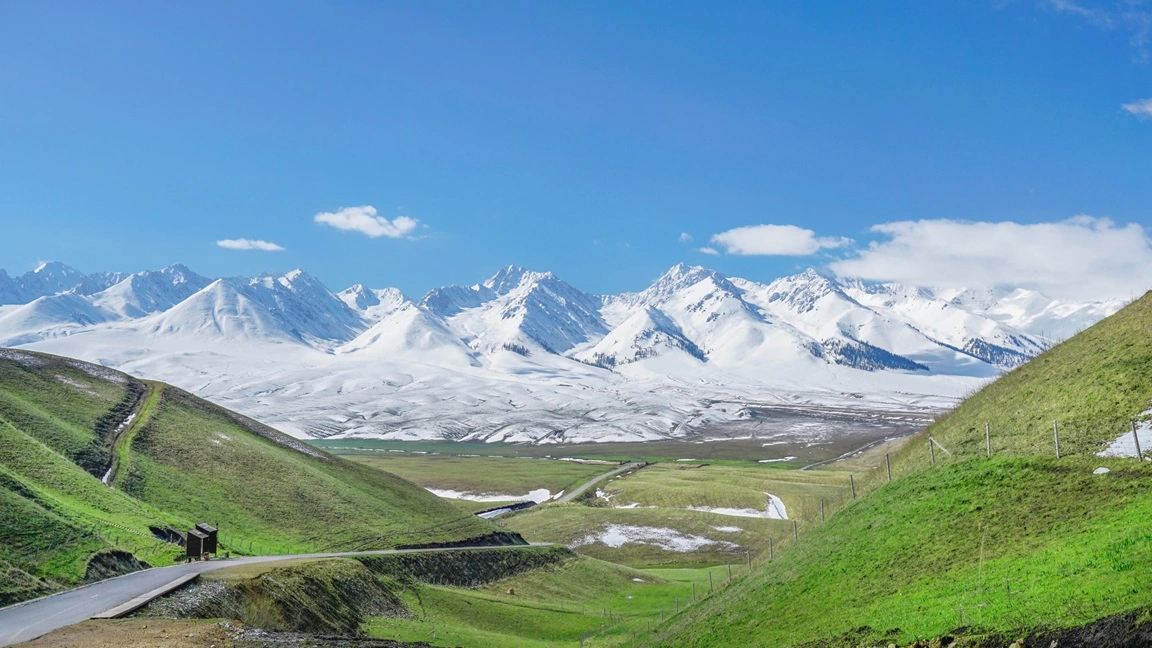
We had a few moments on that trip that genuinely blew our minds — moments when we realised how much of China we'd missed, and never really knew, even after living here for years. One of them came in Xinjiang, in the Ili Valley. We were on horseback, riding up toward our camp near Fairy Lake, with cattle grazing on green slopes and cold rivers running down from the peaks.
"Coming from Switzerland, riding up through those mountains, for a few seconds I felt like I was home in the Swiss Alps. I had no idea China had landscapes like that." — Florian
But the spell broke quickly, in the best way: as we reached the camp we saw the beautiful Kazakh-style yurts, and a family from the Kazakh minority invited us into one, welcoming us with hand-pulled noodles and lamb barbecued over an open fire. We were somewhere completely, wonderfully different.
[Kazakh minority yurts and preparing lamb for dinner.]
That diversity never let up. In Inner Mongolia we crossed vast grasslands and met the nomadic culture that still lives on them. In Guizhou we explored hidden caves tucked into the mountains and some of the most beautiful old wooden villages we'd ever seen. In Xinjiang we drove from snow-capped peaks to sand desert in a couple of days, passing through one minority culture after another. And in Yunnan, near the edge of Tibet, we found mystical snowy mountains and a deep, living Buddhist culture.
Zhihui felt it just as sharply — maybe more. She was awed by the landscapes, and amazed at how much had changed: the new tunnels and bridges threading through even Guizhou, long one of China's poorest provinces. As a serious foodie, she was in heaven, working her way through every local specialty she could find.
"Although I was born in China, I felt like I was discovering it for the first time — places that looked, felt and tasted nothing like my native Zhejiang." — Zhihui
Our share of hiccups
[A real moment from the road: fitting snow chains on a snowy mountain pass.]
We had our share of hiccups, of course. We hit Yunnan in the snow, got stuck on a mountain pass, and fitted snow chains while the flakes came down. Another time, while crossing the world's second-largest shifting-sand desert, our car bogged down in soft sand at the roadside; we dug under the wheels and piled branches for grip, and nothing worked — until a passing driver simply stopped, hooked up a rope, and pulled us free. He didn't ask for anything; he only reluctantly accepted some milk we offered as thanks. During the trip there were also a few places, especially around the borders, that turned out to be off-limits to foreigners, just yet. The officials were lovely about it and genuinely sorry we couldn't go — so kind, in fact, that they offered us tea before we carried on our way.
What surprised us most
But the surprises ran overwhelmingly the other way. People were welcoming everywhere we went. The roads were easy and a genuine pleasure to drive, with wide-open space and enormous views. We discovered how many Chinese families and friends are now road-tripping themselves — it's a real, growing movement — and we fell in love with the little roadside coffee stands, run by friendly owners always happy to chat and help. Road tripping in China could be a true adventure, but it could also be as comfortable and relaxed as a drive through Italy.
"What surprised me most was the diversity of the landscape — and how fast it changes as you drive. Snow-capped mountains, desert, vast open plains, all in a single trip." — Florian
[Climbing the stairs to get to our homestay in a old wooden village in Guizhou.]
Wherever a homestay was available, we'd choose it — and those stays led to some of our most memorable moments. Some of our best meals weren't in restaurants at all but in villagers' own homes; in one roadside village near our guesthouse we were served an authentic farmhouse dinner right in the courtyard, beside the family's kitchen. In Anji, we stayed at a farmhouse guesthouse in a small village tucked into the hills and surrounded by bamboo forest. One afternoon we climbed the hill behind the homestay, and near the top we were surprised — and they were surely even more surprised to see us — to come across a very old woman living there with her grandchild, in a house that must have been more than a hundred years old. Ancient furniture, the barest of essentials; it felt as if the place had never moved with time. They invited us in to sit, served us tea to welcome us, and we gave them Swiss chocolate to thank them.
[Eating a traditional Xinjiang fish dish on the terrasse of a local restaurant ]
"It was surreal — it felt like time had gone back to the China of thirty years ago." — Zhihui
[Crossing the desert on the famous G580 road]
The hospitality often went further than we expected. In Maolan, a small village inside a nature reserve in Guizhou, our homestay owner not only cooked us a generous dinner but waved us over to the porch to taste the dish he was proudest of — a "special," he announced with a grin: fried spicy pig's lungs. Across the village, neighbors were taking turns cooking big meals and inviting everyone in to share. It might not sound tempting to everyone, but we tried it, were pleasantly surprised, and loved being part of the evening with him and his friends.
[The hotel-room slide with the giant teddy bear in Guizhou.]
In the end, we were simply wrong to be anxious. The trip was smoother than we ever expected, and the kids loved it — so much thought goes into making places welcoming for children here. We'll never forget their faces in one Guizhou hotel when they found the owner had built a slide right inside the room, and set out a giant teddy bear and a pile of toys for them. And there was always something for the kids to do: in the Old Town of Lijiang, in Yunnan, they discovered the Dongba culture of the Naxi people, and our eldest even learned to write their own name in Dongba script — an ancient pictographic writing.
[Lijiang Old Town: our eldest learning to write his name in Naxi Dongba script.]
Why we started Dragon Roads
By the time we got home and started telling friends and family about our adventures, one thing stuck with us. Road trips through Iceland, Canada, or Italy are completely normal — but driving across China is almost unheard of. Most people we told had no idea it was even possible for a foreigner to drive here, and the few preconceptions they did have (chaotic traffic, signs only in Chinese, foreigners not allowed behind the wheel) were nothing like what we'd experienced.
"Most people we told had no idea it was even possible to drive in China as a foreigner. We wanted to change that." — Florian and Zhihui
[Our family in the countryside of Shanghai in a bamboo forest.]
So in late 2025, we launched Dragon Roads. Our goal is to help people from all over the world meet the China we met out on those roads — the China beyond the big cities, beyond the Great Wall and the Shanghai skyline. And if, along the way, we can bring a few more visitors to the warm rural communities that welcomed us so generously, that's a bonus we'd be proud of.
— Florian and Zhihui, co-founders of Dragon Roads