Best road trips in China: which region to drive, and when
China is massive, so pick one region and enjoy it properly. The four parts of China best suited to a road trip compared: the northwest, the southwest, the north and the east, with what each is like, when to go, who it suits, and our routes.
China is massive. It is similar in size to the United States, and it is larger than all the countries of the European Union put together. There are so many places to see that choosing can feel a bit overwhelming, so our first piece of advice is simple: pick one region and enjoy it properly, rather than try to see everything in one trip.
Four parts of China are best suited to a road trip: the northwest, the southwest, the north and the east. They have the most scenic drives and the routes people remember. Below we go through them one by one, so you can find the one that fits you, whether you travel as a couple or as a family with children.
Drive on gobi desert in Gansu
The four regions at a glance
| Region | Character | When | Ideal for | Highlights |
|---|---|---|---|---|
| The northwest The "Asian heartland" |
Magnificent landscapes and the ancient Silk Road. | Spring, summer and autumn | Experienced drivers and adventure seekers | Ili (Xinjiang), Southern Xinjiang, the Qinghai and Gansu loop |
| The southwest The "mystical highlands" |
Pristine nature and high ethnic diversity. | All year | Nature lovers and culture explorers | Guizhou province, Yunnan province (Shangri-La), Sichuan province |
| The north The "nomadic steppe" |
A nomadic frontier with vast, untouched grasslands. | Spring, summer and autumn | Everyone: easy drives and cool summers | Hulunbuir (Inner Mongolia) |
| The east The "land of fish and rice" |
Prosperous countryside, ancient towns and bamboo forests. | All year | Everyone: short drives and high comfort | Zhejiang province, Anhui province (near Shanghai) |
Which one is right for you?
If you already know what kind of trip you like, this is the short version.
- If you are an experienced driver and you want adventure, big landscapes and Silk Road history, look at the northwest.
- If you love nature and want to meet many different cultures, look at the southwest.
- If you want easy drives and a cool summer, look at the north.
- If you want short drives and a lot of comfort, with no domestic flight, look at the east.
Driving into a remote mountain area in the southwest
Which region is good in which season?
There is always a region in season, so the real question is not "when is the best time to visit China", but "which region is good when I can travel".
| Region | Spring | Summer | Autumn | Winter |
|---|---|---|---|---|
| The northwest | yes | yes | yes | – |
| The southwest | yes | yes | yes | yes |
| The north | yes | yes | yes | – |
| The east | yes | yes | yes | yes |
Spring, March to May
- The east (Anji, Wuzhen, Huangshan) has mild weather and short drives, but expect rain, because a lot of it falls early in the year.
- The southwest is cool and green, and quieter than in summer.
- The northwest opens from late April, when the grasslands turn green. The nights are still cold.
- The north Hulunbuir grassland starts to turn green in late May.
Summer, June to August
- The north has cool summers, open grassland and easy driving, so it is a good choice for families.
- The northwest is in its main season, with long days, warm afternoons and every road open. The distances are long in some days, so it suits people who like driving.
- The southwest stays cool in the highlands while the lowland cities are hot. Guizhou has its rainy months from about May to mid-August: the roads are mostly fine, but the views are not always there.
- The east is hot and humid. Do what many local people do, and head for the nearby mountains, where it is cooler.
Autumn, September to November
- The northwest has clear skies, dry cool air and autumn colors in October. November gets much colder and snow starts.
- The north turns amber in September. Go early, because it gets cold fast.
- The east is at its best in October and November. Mild temperatures, evergreen bamboo forests, and quieter water towns.
- The southwest is dry and clear again, and Guizhou harvests its rice terraces in September and October.
Winter, December to February
- The southwest has mild days, lower prices and empty trails. North of Shangri-La can have ice, but most of Yunnan is fine.
- The east is as quiet and nice in winter as in autumn.
- Wait for the northwest and the north. The winters are very long there. Snow and ice close mountain passes and rural roads, and the grassland regions reach minus twenty.
The northwest: the "Asian heartland"
The Northwest: the "Asian heartland"
Northwest China, especially Xinjiang, Qinghai and Gansu, is one of the best parts of the country for a road trip. A lot of China's classic self-drive routes are right here, and driving them gives you a real sense of scale and openness.
What strikes people most is how varied the landscapes are, and how fast they change. You drive over a mountain pass between snow-capped peaks, and when you arrive on the other side you are in wide open grassland. As you continue, the road runs through forests and alongside rivers and lakes, and then it changes again into desert with sand dunes. One of the main reasons is that many mountain ranges divide the area, and each part has its own scenery.
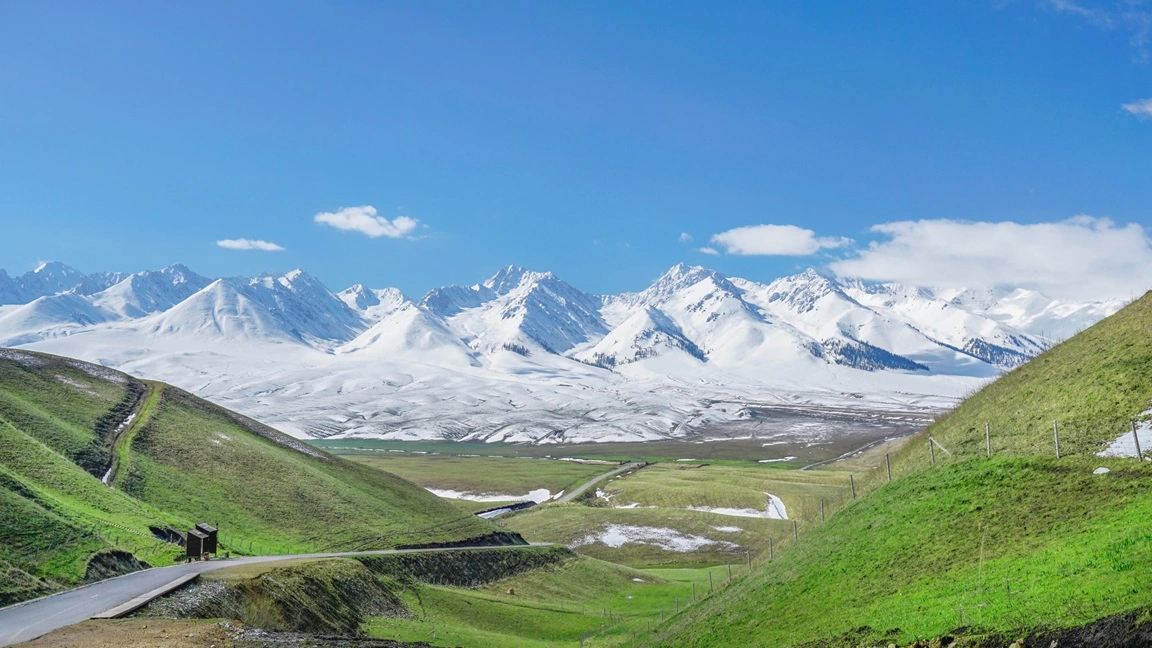
In the north of Xinjiang, the Ili River valley is the place that shows this best, with grasslands backed by snow-capped mountains and a rich variety of plants and wildlife. Another road trip, the Qinghai and Gansu loop, lets you feel how deep the history of the Silk Road is, with big landscapes all the way.
The region is just as varied in its cultures. Xinjiang has a large Muslim population, Gansu was a key place for the spread and exchange of Buddhist culture, and Qinghai is a great place to see everyday Tibetan life. The food is simple but tasty: a lot of beef, lamb and noodles, with bold spices. The region is also well known for its fruit, such as apples, grapes and melons.
The climate is generally dry, with a lot of sunshine and big temperature changes between day and night. Besides the landscapes, there is plenty to do along the way: ancient sites, monasteries, mosques and museums, or hiking, horse riding and even camping.
The northwest is huge, so you will probably spend more time on the road here, getting from one place to the next. But some of the most beautiful scenery is right along the way. It is not as developed as China's coast, but tourism infrastructure has improved a lot, and travel here is now pretty comfortable.
Our routes in the northwest:
The southwest: the "mystical highlands"
The southwest: the "mystical highlands"
Southwestern China is mainly the provinces of Yunnan, Guizhou and Sichuan. It has landscapes, ecosystems and wildlife that you cannot find anywhere else. A long history of geological activity and a lot of water have shaped it: snow mountains, glaciers and limestone peaks stand above deep gorges, hidden caves and even tropical rainforest.
This is also where the largest number of China's ethnic minority groups live. Many communities still keep their own language, their traditional clothing, their festivals and their way of life, which makes the cultural side of a trip here especially deep. Shangri-La, which many people have heard of, is in the north of Yunnan. And deep in the forests of Guizhou live the Miao, one of China's oldest ethnic groups, known for their music, their dancing and their warm hospitality.
When it comes to food, the southwest is one of the most exciting regions in the country. It is the birthplace of hot pot, and the flavours are often spicy, numbing, sour and bold, whichever you prefer. Yunnan is also known as the kingdom of wild mushrooms, with more than one third of the world's edible mushroom species.
There is no shortage of things to do. You can visit old minority villages or sacred Tibetan Buddhist sites, or get outdoors for hiking, mountain climbing and cave exploring. Yunnan in particular has some very good hiking routes. At Tiger Leaping Gorge you walk along a river canyon between very high mountains, and Yubeng is a remote village surrounded by snow peaks and sacred landscapes, with trails leading out to them.
The climate varies a lot with the area and the altitude, but many of the popular places have mild weather. Yunnan is often described as having spring weather all year, and most places can be visited in any season.
The scenery is so rich, and there is so much to see along the way, that it is usually best to focus on one province at a time. Each one deserves enough time to explore it properly.
Our routes in the southwest:
Why is Tibet not here?
You may wonder why we did not mention Tibet, since it is also in southwestern China. For now, foreigners cannot visit Tibet on their own. They can only go as part of an organized, guided tour, so a self-drive trip there is not an option. The good news is that you can still see Tibetan culture on self-drive trips in the provinces nearby, including Yunnan, Qinghai and Sichuan.
The north: the "nomadic steppe"
The north: the "nomadic steppe"
Apart from Beijing, the real highlight of northern China is Inner Mongolia, a great place to see China's northern nomadic culture. A popular choice, and we would say the best one, is the Hulunbuir grassland. It is one of the four largest grasslands in the world, and people often call it the most beautiful and the purest grassland in Asia.
Hulunbuir also borders the Greater Khingan forest, the largest untouched forest in northern China, which makes it a perfect summer escape with comfortable, cooler temperatures. And because it is near the borders of China, Russia and Mongolia, you can feel three very different cultures in one place.
For food, you will find plenty of northeastern Chinese dishes, served in generous portions, along with grassland beef, lamb and dairy. You will also find some surprisingly tasty Russian dishes, which are a local speciality too. You can ride a horse across the grassland, visit the reindeer in the northern forests, or stay in a traditional Mongolian yurt to see how the local herders live.
The climate in the north is very seasonal, with clear temperature differences between day and night. Because of the higher latitude the winters are very long, so spring, summer and autumn are the best times to visit.
The easiest way to reach Hulunbuir is to fly from Beijing, which takes just two hours. Once you are there, the roads are simple and well connected, which makes it a perfect destination, and maybe even the best one, for a first self-drive trip in China.
Our route in the north:
The east: the "land of fish and rice"
The east: the "land of fish and rice"
Self-drive trips in eastern China usually centre on Shanghai and the provinces of Zhejiang, Jiangsu and Anhui. This region is often called the Yangtze River Delta, and it is one of China's most developed and innovative areas, with an excellent road network that makes getting around very easy.
What many travellers do not know is how much nature and history there is here. It is home to one of China's oldest civilisations, so you find a lot of historic cities, former capitals and towns that go back more than a thousand years. With its mild climate, its mountains and bamboo forests, its villages and rivers, and everything there is to do and see, it is easy to understand why this region is such a good choice for a road trip.
Some of the places you will find here are West Lake in Hangzhou, the bamboo sea at Anji, the old waterways of Wuzhen, and the high peaks of Huangshan, the Yellow Mountain.
East China is known as the land of fish and rice. Because of its many waterways and its fertile land, rice, fish and shrimp are everywhere, and they have shaped a food culture that is very varied and different from place to place. Wherever you go, you will find something tasty and satisfying.
Besides hiking through the mountains and along the rivers, you can wander through bamboo forests and tea plantations, or explore old towns and villages. The climate is generally warm and humid, with a lot of rain early in the year. During the hotter summer months, many local people head to the nearby mountains to escape the heat.
And since it is close to Shanghai, you can start your trip from there without any domestic flight, which saves you money and gives you more flexibility.
Our route in the east:
Which weeks should I avoid?
Three weeks a year, the whole country travels. Prices go up, hotels sell out, and the famous sights are full. You can still travel then, and the back roads stay quiet, but book three months ahead or choose a region where few other people are going.
| Holiday | 2026 | 2027 | What happens |
|---|---|---|---|
| Chinese New Year | 15 to 23 February | 5 to 13 February | Hundreds of millions go home. Flights and trains are full, many restaurants close for a week, and the roads are surprisingly quiet. |
| Labour Day | 1 to 5 May | 1 to 5 May | Cities and big sights are crowded. Short-distance trips are popular. |
| National Day, Golden Week | 1 to 8 October | 1 to 7 October | The busiest week of the year everywhere. More people travel far. |
School holidays matter less for drivers. They run from late June to the end of August, and from mid-January to mid-February. Families travel then, so the popular sights are busier, but the roads are not.
Questions we get asked
Can I do two regions in one trip?
Yes, in about three weeks, with a flight between them. Inside the southwest, Yunnan and Guizhou are neighbours, so you can join them by road. Or, you can use a flight to connect two completely different places, It gives you a simple break partway through the trip, and adds more variety to your road journey. Ask us for free customization.
Which region needs the most driving experience?
The northwest, because it is huge and you spend more time on the road. Also, you may pass through areas at higher elevation, and may need to wind your way up and over some mountain passes. In the southwest, visiting untouched villages or remote mountain areas may also mean driving on some rugged mountain roads.
When should I not travel?
Avoid the first week of October, the Chinese New Year week and the first days of May, unless you book three months ahead and accept the crowds at the famous sights. The dates are in the holiday table above.
How far ahead should I book?
At least two to three months ahead. Hotels in the northwest and the north could sell out in summer.
Do I need permits for any of them?
On the routes we drive, you need no permit beyond the visa and the driving permit. A few border sites in Xinjiang need a pass, and that is arranged before the trip.
Watch this guide as a video
If you would rather watch than read, we made a video about the same regions: where to go, and when.
Next step
Once you know the region and the season, check the paperwork.